
The AI Expertise Paradox: Why Better Tools Demand Better Humans
Autonomous AI agents are reshaping workflows and rewriting job roles, but deep human expertise is still your biggest asset.
Most businesses are still using AI as a basic chatbot. You type a prompt, it gives you an answer, and you copy paste it – creating a slow, manual loop that uses AI models as reactive assistants.
But a deep structural transformation has been quietly taking place: the transition from conversational AI to agentic systems.
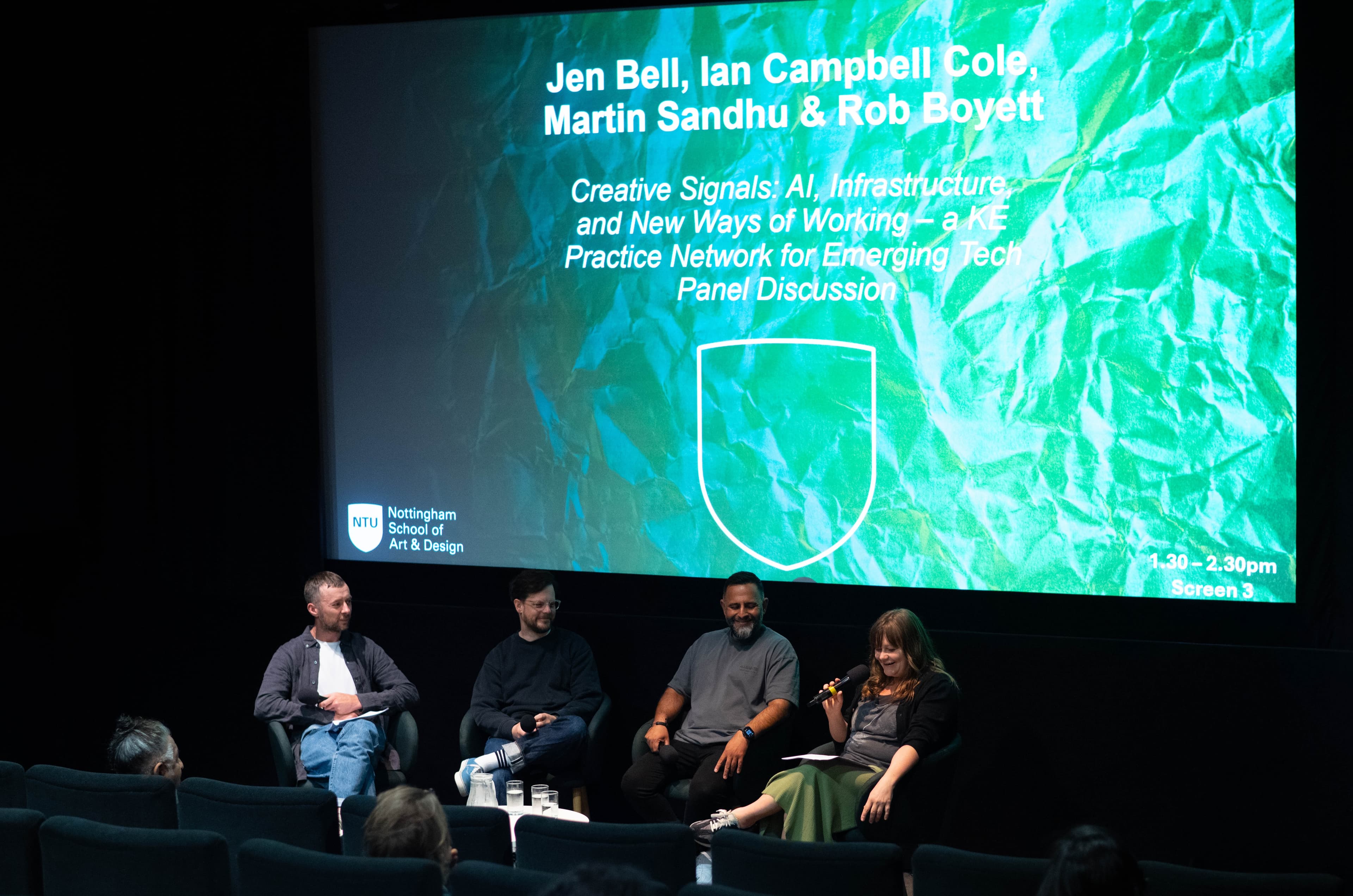
At a recent Knowledge Exchange Practice Network (KEPN) panel hosted by Nottingham Trent University (NTU), I sat down with Rob Boyett and co-chairs Jen Bell and Ian Campbell Cole to discuss what exactly this shift means for creative professionals, tech leaders, and organisational design.
The core takeaway: The software itself isn’t the story anymore. The real challenge now is how we manage systemic efficiency, protect knowledge, and preserve the human touch.
What does ‘Agentic’ really mean?
Conversational AI requires constant human intervention. You prompt, the model responds, you evaluate, and you prompt again.
Agentic AI operates on a fundamentally different premise. You assign an agent a complex, open-ended goal. The system then autonomously plans the steps, writes the necessary code, gathers external data, iterates through errors, and delivers a completed project.
In my own consulting work, I routinely build these systems to act as ‘AI employees’. For example, I designed an automated research agent named Larry. Larry doesn’t just answer questions, he independently monitors market shifts, extracts datasets, structures competitive intelligence, and files reports. By delegating these administrative tasks to Larry, my team and I are handed back the time required for high-leverage strategy work.
The Pre-requisite of Expertise: ‘Knowing What Good Looks Like’
While agentic workflows compress the timeline between an initial idea and a deployment-ready product, they introduce a new problem: massive information overload.
Because it is now so easy to spin up new ideas and test them, I know people who are staying up until 4:00 am coding and designing simply because the feedback loop is addictive. But when an AI hands somebody twelve different, high-value directions at once, it completely overwhelms them if they are not able to prioritise objectively.
This means that your role as a professional shifts. You stop being the person who manually plans and designs the assets, and you become the curator. Your job evolves into now sifting through the noise to build a clear, human narrative.
This leads to a harsh truth for most business leaders: AI is only useful if you already have deep expertise.
If you can’t set clear parameters for ‘what good looks like’, these autonomous systems will just generate piles of high-volume mediocrity – or what has now been dubbed ‘AI slop’. This is why hands-on training, mentorship, and peer reviews are more important than ever. You have to build the critical judgement to spot errors that automated tools often miss.
How Automation Changes Corporate Roles
We are not facing wholesale robot replacement. But, we are entering a period of productivity amplification that will fundamentally reshape team structures and hiring criteria.
When I audit an organisation’s workflow, the very first question I ask across any department is structural: ‘Can the mechanical or repetitive parts of this specific job be automated?’
This is now driving a visible shift in the employment market.
- The decline of production-only roles: Roles that purely focus on technical delivery of an asset (like minor coding fixes or basic graphic production are shrinking).
- The rise of the generalist: Value is shifting toward individuals who have a broad understanding of various technologies and how they connect, as opposed to just one deep, manual skill.
- Fluidity of ownership: Traditional operational silos are disappearing. Tasks like basic project management are now becoming automated, shared skills across a whole team rather than just one person’s sole job.
What Should We Not Automate Now?
When execution becomes cheap, easy, and accessible, unique human traits become your primary competitive advantage. These are two areas which I believe should never be handed over to machines:
- Authentic Marketing: The internet is crawling with lazy, AI-generated social media text and stock images. Because anybody can create it with a few prompts and the click of a button, it all sounds exactly the same. To stand out, you need real human perspective so your content comes across as personal and real.
- Live Workshops: When running a collaborative meeting or a workshop, trying to take notes or manage decks can be distracting. A better way to approach recording the content is to record audio from the meeting or workshop, and use an AI platform to clean up the notes after you finish. This keeps you entirely focused on the actual people in front of you.
The skills that matter now more than ever are the human ones: presence, curiosity, storytelling, and sharp critical judgement.
Overcoming Corporate Roadblocks
Deploying the tech is rarely the hardest part of a digital transition. The real friction is cultural.
Established companies are built to resist rapid change. They are held back by old processes and siloed departments. Digital-first success stories, like Zopa bank, didn’t just get ahead by throwing AI onto old ways of working. They succeeded because they decided to forgo old corporate structures and built a lean operating model from scratch.
Simply layering automated tools on top of an inefficient system will just make you produce waste faster. A true transformation means you have to be willing to look at your business layout and rebuild it properly.
Preserving Your Institutional Memory
When businesses automate too quickly, they risk a massive hidden danger: losing tacit knowledge.
Every business has ‘linchpins’ – the people who aren’t necessarily running the boardroom, but who know exactly how to fix a system when it breaks. If you automate or cut roles without a plan, that unwritten knowledge leaves the building for good.
In my practice, I often work alongside business owners for 12 to 18 months before a company is sold. Our main goal is to map out that undocumented employee intuition and turn it into functional training data. Without this, organisations end up accidentally rebuilding the same projects every few years because old team members moved on and took the memory with them.
The most successful enterprises are building compounding knowledge systems. They securely log internal decision, video meetings, and emails to create a database. When an AI agent can read that history, it stops acting as a generic tool and starts functioning like an expert team member who knows your operations inside out.
When to Hit the Brakes
Automation is not a silver bullet, and it fails often. Working with an unoptimised AI agent can feel exactly like managing a detached, offshore tool that refuses to follow instructions.
The fix in this scenario is not to write longer or more complicated prompts. You have to break tasks down into smaller, linear steps, set strict rules, and check the output at every stage.
We also have to come to terms with the fact that faster isn’t always better. In deep strategic, creative, or philosophical work, slowing down has great value. The space between a concept and its execution is where original ideas actually grow.
The Strategic Path Forward
AI isn’t just something that is happening to us – we choose how to build it.
If you company’s current AI strategy is just handing your team a ChatGPT login, or access to Gemini, you are falling behind. The next wave of successful business will be built on autonomous systems, data sovereignty, and structural resilience. The companies that win, will use agents for heavy operational lifting – while fiercely protecting the human elements that keep their business real.
Considering auditing your AI setup?
If you want to audit your current operations, need help identifying what to automate, and build a resilient agentic setup that actually frees up your time, let’s talk. Book an AI discovery call with me here.
Ready to turn your idea into a product users actually want?
Book a free discovery call
Martin Sandhu
Fractional CTO & Product Consultant
Product & Tech Strategist helping founders and growing companies make better technology decisions.
Connect on LinkedIn